
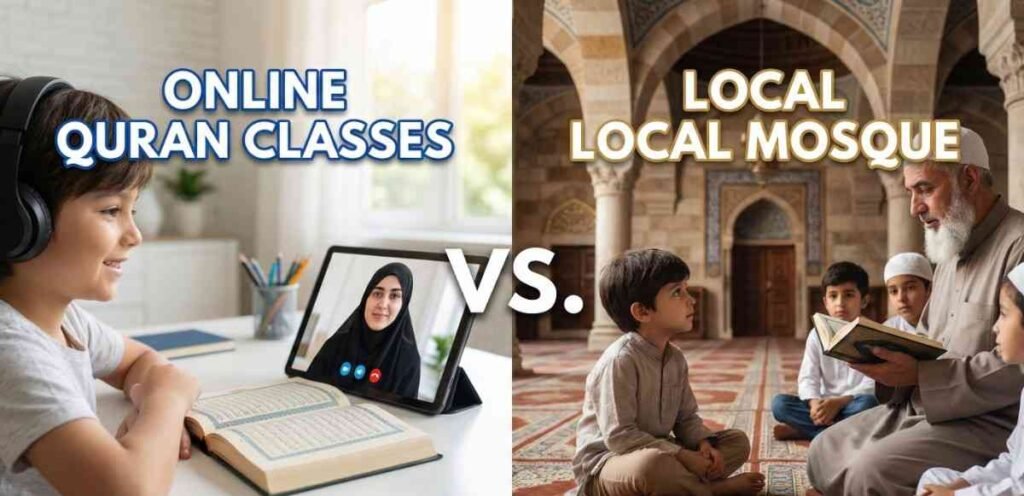
In the life of every Muslim parent, a moment arrives when a crucial decision must be made: How will my child learn the Quran?
For generations, the answer was simple. You would send your child to the nearest local mosque or madrassah. It was a rite of passage. However, we are living in a digital age where education has transformed. Today, parents in the UK, USA, Canada, and UAE are increasingly asking a new question: “Are Online Quran Classes vs. Local Mosque education better for my specific situation?”
It is not just about convenience; it is about quality, safety, and spiritual connection. Whether you are considering Online Quran Classes vs. Local Madrassah or a private home tutor, the goal remains the same—to instill a love for the Book of Allah in your child’s heart.
This comprehensive, 2000-word guide will break down every aspect of this debate. We will analyze the pros and cons of Online Quran Classes vs. Local Mosque learning environments, covering attention spans, teacher qualifications, safety, cost, and flexibility, so you can make an informed choice for your family.
1. The Core Difference: 1-on-1 Focus vs. Group Learning
The most significant factor that affects a child’s learning speed and accuracy is the amount of direct attention they receive from their teacher.
The Reality of the Local Mosque
In a traditional local mosque or madrassah setting, the environment is almost always a group class. A single Qari or teacher is often responsible for managing 20 to 30 children simultaneously.
- The “Waiting Game”: In a one-hour session, the teacher has to divide their time among all students. Mathematically, this means your child might get only 3 to 5 minutes of actual recitation time.
- Passive Learning: For the remaining 55 minutes, the child is often sitting idly, chatting with friends, or waiting for their turn. This passive time can lead to boredom and a lack of discipline.
- One Speed for All: Group classes often move at the pace of the average student. If your child is a fast learner, they may feel held back. If they struggle with specific Tajweed rules, they might be left behind because the teacher cannot pause the whole class for one student.
The Power of Online Quran Classes
When comparing Online Quran Classes vs. Local Mosque, the online model typically operates on a 1-on-1 basis. This is a massive educational advantage.
- 100% Dedicated Attention: At Al Qalam Online Quran Academy, when your child logs in for a 30-minute class, they receive 30 minutes of undivided attention. The teacher is listening to every letter, every vowel, and every breath.
- Immediate Correction: Mistakes are identified and corrected instantly. This prevents the “fossilization” of errors, where a child learns to pronounce a letter incorrectly and struggles to fix it years later.
- Customized Pace: The syllabus revolves around your child. If they need two days to master the pronunciation of ‘Qaf’ vs. ‘Kaf’, the teacher spends two days on it. If they can memorize a Surah in one day, they move forward immediately.
Winner for Quality of Education: Online Quran Classes (1-on-1)
2. Logistics: The Struggle of the Commute vs. Comfort of Home
For Muslim families living in Western countries, the logistics of daily life are a major hurdle in Islamic education.
The Commute Challenge
Let’s be honest: the “Pick and Drop” routine is exhausting.
- Time Drain: Driving 20 minutes to the mosque and 20 minutes back, plus waiting time, can easily eat up an hour of your day—time that could be spent on homework or family bonding.
- Weather Conditions: In countries like Canada, the UK, or parts of the USA, winter brings early sunsets, snow, and icy roads. Dragging a tired child out into the freezing cold at 5:00 PM for a madrassah class is difficult and can lead to burnout.
- Fatigue: Children often arrive at the mosque already exhausted from a full day at school. Adding a commute on top of that reduces their mental energy for Quranic studies.
The Convenience of Online Learning
When weighing Online Quran Classes vs. Local Madrassah, the convenience factor is undeniable.
- Zero Travel Time: The classroom is just a click away. There is no traffic to fight and no fuel to burn.
- Fresh Mindset: Because the physical exertion of travel is removed, children are often fresher and more receptive to learning when they sit down in their own comfortable chair at home.
- Anywhere, Anytime: Are you traveling for a holiday? Visiting relatives? As long as you have an internet connection and a tablet, your child’s Quran education travels with you. You never have to miss a lesson.
Winner for Logistics: Online Quran Classes
3. Safety and Parental Supervision
In today’s world, the safety of our children is paramount. This is often the deciding factor for parents choosing between Online Quran Classes vs. Local Mosque.
Safety Concerns at Local Institutions
While mosques are sacred spaces, they are public venues.
- Lack of Supervision: In large classes, it is difficult for one teacher to monitor the behavior of every child constantly. Bullying among students or distractions are common issues.
- Unknown Interactions: Parents are usually not allowed inside the classroom. You do not know exactly how the teacher is disciplining your child or what conversations are happening between older and younger students.
The Transparency of Online Classes
Online learning brings the madrassah into your secure home environment.
- Complete Visibility: You can sit right next to your child during the class. Even if you are cooking dinner or working in the next room, you can hear exactly what is being taught and the tone of voice the teacher is using.
- Safe Environment: There is no risk of bullying from other students or exposure to unvetted individuals. Your child learns in the safety of their own home.
- Recorded Sessions: Many online platforms, including Zoom and Skype, offer the option to record lessons, allowing you to review your child’s progress later.
Winner for Safety: Online Quran Classes
4. Teacher Qualifications and Compatibility
Finding the right teacher is like finding a needle in a haystack.
Local Limitations
When you choose a local mosque, you are limited to the staff available in your specific zip code.
- Language Barriers: In many local mosques in the West, the Imams are extremely pious and knowledgeable but may struggle to communicate effectively in English. For children born and raised in the UK or USA, this language barrier can create a disconnect. They might learn to recite (parrot-fashion) without understanding the instructions or the meaning.
- Cultural Disconnect: Teachers who have recently arrived from overseas may not understand the cultural context or the psychology of Western-raised children, sometimes using stricter teaching methods that don’t resonate with sensitive kids.
Global Talent Pool Online
Online Quran Classes vs. Local Madrassah offers a distinct advantage here: access to a global pool of talent.
- Certified Experts: At academies like Al Qalam, we hire the top 1% of tutors from countries with a rich history of Quranic scholarship (like Egypt and Pakistan). Our teachers are certified Huffaz with Ijazah.
- Language Proficiency: We specifically select tutors who are fluent in English. They can explain Tajweed rules using modern examples and connect with children on a personal level.
- Female Tutors: For parents looking for female tutors for their daughters, local mosques often have limited availability. Online, you can easily find qualified female scholars for your daughters or sisters.
Winner for Teacher Quality: Online Quran Classes
5. Cost Analysis: Is Online Learning Expensive?
Many parents assume that private 1-on-1 tuition is a luxury they cannot afford. Let’s break down the true cost of Online Quran Classes vs. Local Mosque.
The Hidden Costs of Local Madrassahs
On paper, a local mosque might charge a low monthly fee, perhaps $20-$40. However, the “real” cost is higher.
- Fuel & Wear: Driving back and forth 3-5 days a week adds significant fuel and vehicle maintenance costs.
- Time Value: If a parent spends 5 hours a week driving, that is 20 hours a month. What is the value of your time?
- Registration Fees: Many local centers have annual registration or material fees.
The Value of Online Academies
Online academies typically charge between $30 to $50 per month depending on the plan.
- All-Inclusive: This fee usually covers the tutor’s salary, digital materials, and platform costs.
- No Hidden Costs: You pay zero for travel.
- Flexible Plans: Academies often offer 3-day, 4-day, or 5-day plans, allowing you to pay only for the classes you need.
When you factor in the 1-on-1 attention (which helps the child learn 2x-3x faster), the Cost-Per-Milestone (e.g., cost to finish the Qaida) is often lower online because the child finishes the course much sooner.
Winner for Value: Tie (Depends on budget vs. time value)
6. Flexibility of Schedule: 24/7 Learning
Life does not run on a 9-to-5 schedule anymore.
Rigid Mosque Timings
Local madrassahs usually operate in a specific window, typically 5:00 PM to 7:00 PM.
- Conflict with Activities: This time slot often clashes with soccer practice, swimming lessons, or homework time.
- Missed Classes: If you have a family wedding, a dentist appointment, or a late day at work, the class is missed. There are usually no “makeup classes” in a group setting.
Online Freedom
When comparing Online Quran Classes vs. Local Mosque regarding time, online wins hands down.
- You Choose the Time: Whether you want classes at 6:00 AM before school or 8:00 PM after dinner, online tutors are available 24/7 due to global time zone differences.
- Rescheduling: If your child is sick, you can often reschedule the class with the tutor, ensuring they don’t miss out on their lesson.
Winner for Flexibility: Online Quran Classes
7. The Social Aspect: The Mosque’s Strength
We must be fair. There is one area where the local mosque excels: Socialization.
- Community Building: Attending the mosque connects the child with the local Muslim community. They make Muslim friends, pray in the congregation (Jama’ah), and absorb the Islamic atmosphere.
- Adab and Etiquette: Being physically present in a Masjid teaches a child respect (Adab) for the House of Allah in a way that a virtual classroom cannot fully replicate.
Our Recommendation: Use online classes for academic learning (Nazra, Hifz, Tajweed) to ensure progress, but take your children to the mosque for Jummah, Eid, and weekend events to fulfill their social needs.
Conclusion: Who Wins the Battle?
The debate of Online Quran Classes vs. Local Mosque ultimately depends on your family’s priorities.
Choose a Local Mosque/Madrassah if:
- You want your child to socialize specifically with local children.
- You live very close to the mosque (walking distance).
- You are on a very strict budget and cannot afford private tuition.
Choose Online Quran Classes if:
- You value quality: You want your child to have 100% of the teacher’s attention.
- You are busy: You need a schedule that fits around your life, not the other way around.
- You want safety: You prefer monitoring your child’s education from home.
- You want results: You want your child to complete the Quran faster and with better Tajweed.
The Verdict
For the modern family living in the West, Online Quran Classes offer a superior educational model. They solve the problems of time, distance, and quality control that have plagued parents for years.
Ready to Transform Your Child’s Quran Journey?
You don’t have to guess. At Al Qalam Online Quran Academy, we invite you to experience the difference yourself. We are rated as the #1 Online Quran Academy because we combine the convenience of technology with the spirituality of traditional learning.
What do we offer?
- ✅ Certified, English-speaking Tutors.
- ✅ Flexible timings (24/7).
- ✅ Personalized 1-on-1 plans (Noorani Qaida, Tajweed, Hifz).
- ✅ A safe, home-based learning environment.
Don’t just take our word for it.
👉 Click Here to Book Your FREE 5-Day Trial Class Today! (No Credit Card Required. No Obligation. Just Pure Learning.)
Frequently Asked Questions (FAQs)
Q1: Are online Quran classes as effective as local mosque classes?
Yes, for many children, they are more effective. Online classes offer 1-on-1 attention, meaning the teacher focuses solely on your child for the entire session, whereas in a local mosque, a teacher divides time among 20+ students.
Q2: What is the best age to start online Quran classes?
We recommend starting as early as 4 or 5 years old. At this age, children are receptive to learning new sounds (Makharij). Our tutors are trained to engage young children using interactive methods.
Q3: Can I monitor my child during the online class?
Absolutely. This is a major benefit of online learning. You can sit beside your child or be in the same room to listen to the lesson, ensuring safety and quality, which is often not possible in a local madrassah.
Q4: Do online Quran academies have female teachers?
Yes, Al Qalam Online Quran Academy has a dedicated team of certified female scholars (Alimahs) for sisters and daughters who prefer a female tutor.
Q5: Is online Quran learning cheaper than a local mosque?
It offers better value. While some local mosques have low fees, the cost of fuel, travel time, and slower progress adds up. Online classes save travel costs and help students complete their courses faster.