
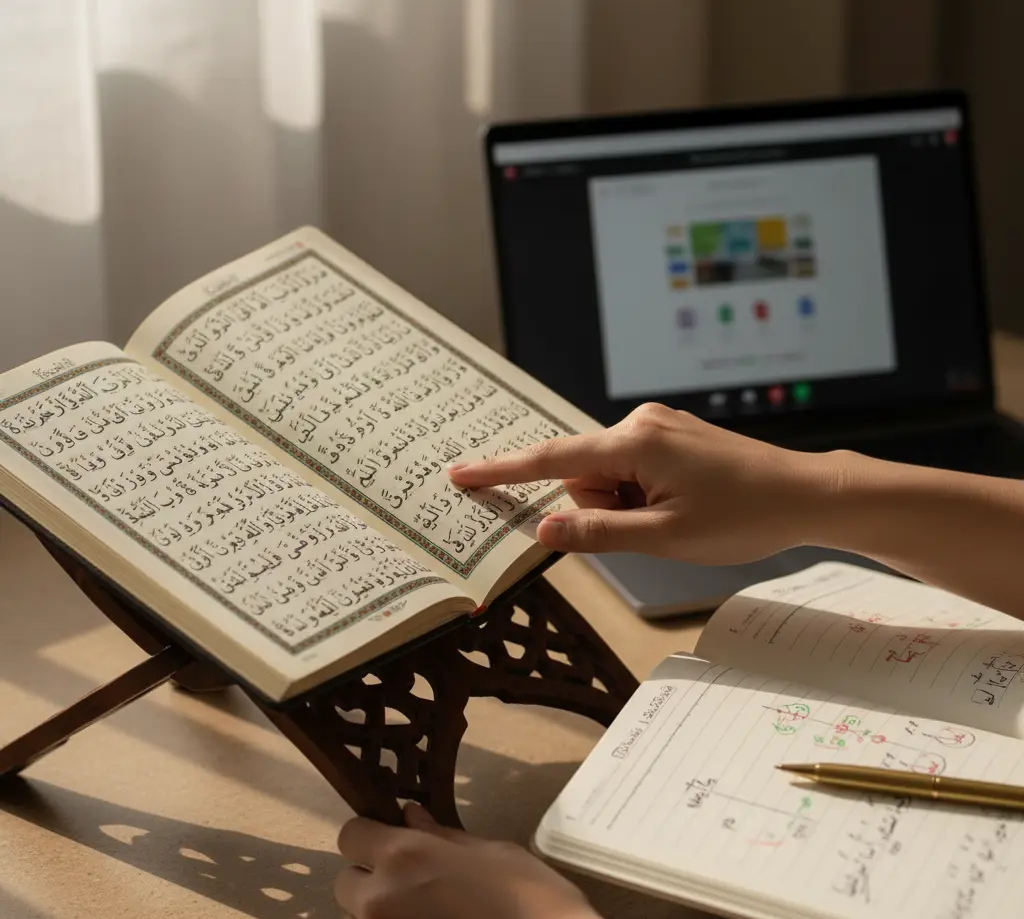
Have you ever read a verse aloud, felt the beauty of it, then wondered whether your tongue gave each letter its right, and whether that care might change what your heart received? Tajweed is not about sounding impressive; it is about protecting meaning and carrying revelation with trust. When each letter comes from its true place and each rule is observed with mercy and balance, the Quran is recited as it was taught, and hearts experience clarity instead of confusion.
Why Precision Guards Revelation
Why Tajweed Preserves Meaning
Arabic letters are precise. A single shift in articulation can blur meanings and weaken the listener’s understanding. Tajweed gives every letter its due, from Makharij (where the sound begins), to Sifat (the qualities that shape the sound), so the message remains faithful while the voice remains humble. This is why teachers insist on slow, measured recitation. Rules like Ikhfa, Idgham, Iqlab, and Ithhar are not decorative; they keep similar sounds clear and prevent accidental changes that might distort a word’s sense in the listener’s ear. Resources dedicated to teaching Tajweed consistently warn that rushing, confusing heavy and light letters, or flattening elongations can alter rhythm and emphasis in ways that cloud meaning; careful practice protects both form and understanding.
Sound, Presence, and the Heart
Tajweed slows the reader just enough to notice each sound and pause, which invites attention and reverence. Many learners describe how their focus deepens when their mouth knows what to do; anxiety eases, and the heart stays with the verse longer. Beautifying recitation, within the bounds of correctness, is encouraged—not to perform, but to offer Allah’s words with care and composure, so the listener, even if it is only oneself, receives guidance with a Why Precision Guards Revelation.
Sound, Presence, and the Heart
Tajweed slows the reader just enough to notice each sound and pause, which invites attention and reverence. Many learners describe how their focus deepens when their mouth knows what to do; anxiety eases, and the heart stays with the verse longer. Beautifying recitation, within the bounds of correctness, is encouraged—not to perform, but to offer Allah’s words with care and composure, so the listener, even if it is only oneself, receives guidance with a calm mind.
The Technical Foundation of Accuracy
Makharij and Sifat: The Foundation
- Makharij: Articulation points from the throat, tongue, lips, and nasal passage ensure that letters which look close on the page do not sound the same in the mouth; this prevents subtle switches that can confuse meaning.
- Sifat: The qualities like heaviness and lightness, breathiness, strength, or softness stabilize a letter’s character so it does not slip into its neighbor’s space, especially in connected recitation.
- Measured pacing: Through Madd (elongation) and clear stops, this keeps the verse’s structure intact—fluent but never rushed—which sustains both accuracy and reflection.
Common Mistakes That Change Meaning, and How to Fix Them
- Mixing heavy and light letters (e.g.ص with س, or ط with ت). The cure is slow pair practice, mirror recitation, and targeted drills on short phrases until the tongue learns the contrast.
- Rushing elongations. Cutting a Madd short or stretching it inconsistently breaks flow and emphasis. Fix this by counting softly with finger taps to train consistency without tension.
- Weak nasalization in Ghunna, especially in Idgham. A gentle, steady hum of the right duration anchors the sound so it supports meaning rather than distracting from it.
- Inattentive stopping and starting. Poor waqf (stop) choices can detach a phrase from its sense. Fix this by practicing with a teacher on common stop points to prevent fragmented meanings.
Deepening Worship and Memory
How Tajweed Strengthens Hifz and Salah
Memory follows sound. When articulation is consistent, the brain forms reliable audio maps of verses, which reduces slips and makes review more efficient. In Salah (prayer), measured recitation draws the heart into presence; you recognize patterns, pauses, and emphasis, and you feel less rushed, more aware of speaking before Allah with words that deserve full attention. Over time, this steadiness turns into a quiet confidence that supports recitation at home and in gatherings, without pride and without fear.
A Simple, Gentle Roadmap to Start Tajweed
- Begin with Makharij, five minutes daily of targeted pairs. Train tongue placement slowly until the feeling becomes familiar and repeatable.
- Add Sifat, practice heavy and light pairs with short, known verses, so the rule lives inside meaningful recitation rather than isolated drills.
- Learn the core Noon and Meem rules (Ikhfa, Idgham, Iqlab, and Ithhar) by applying each to lines you already recite in prayer; your mind ties rule to worship.
- Practice Madd with counting. Natural and secondary elongations become steady through soft, audible counts, then remove the counting once pacing stabilizes.
- Recite to a teacher weekly. Even brief sessions catch subtle errors you cannot hear in yourself and prevent habits from settling; this saves months of confusion.
Cultivating Consistency
What Good Correction Feels Like
Gentle, specific, and immediately applicable. A teacher names the exact letter or rule, demonstrates slowly, invites you to mirror, then assigns a two-line drill to practice the same pattern at home. The tone remains respectful and hopeful; the goal is worship with precision, not performance with anxiety, and progress is tracked in small, visible steps.
Integrating Tajweed into Busy Lives
- Fix a small unit, ten lines or a half page, and return to it daily for a week with one focus (e.g., Ra heaviness and lightness). Depth grows through repetition, not through volume.
- Use voice notes, record a short passage once, listen once, then mark one correction to apply tomorrow. Micro feedback builds momentum.
- Pair with meaning, a brief Tafseer note or one key word keeps the heart engaged so rules never feel detached from guidance.
Signs Your Tajweed is Maturing
- Similar letters no longer feel confusing in the mouth; articulation feels placed, not guessed.
- Madd becomes smooth and even across different verses; the voice stops grabbing at elongations and instead carries them gently.
- Stopping points feel deliberate; you notice where sense completes and where to resume without losing flow.
- In Salah, focus rises and anxiety about mistakes fades; recitation feels calmer, more present, and more honest.
A Four-Week Starter Plan
- Week 1: Makharij pairs and short Surahs. Five minutes of drills, then five of applied reading in a familiar passage, slow and patient.
- Week 2: Noon Sakinah and Tanween. Pick Ikhfa first, mark examples in a short Surah, and practice two lines daily with conscious nasalization.
- Week 3: Madd basics. Count softly to stabilize length, apply in Surah Al Mulk or another familiar portion; do not chase speed.
- Week 4: Review and Waqf. Practice choosing stops and starts, then recite a small selection as a confidence read, noticing how attention changes when stops are clean.
Frequently Asked Questions (FAQ)
Is Tajweed obligatory?
Reciting correctly to the best of one’s ability is part of honoring the Quran; learning the rules that enable correct recitation is the natural path to that goal and protects meaning and respect in worship.
Can adults master Tajweed?
Yes, adults typically progress well with clear feedback and daily micro practice; patience and structure matter more than age.
Does Tajweed make recitation slower?
At first, yes, then it produces a steady, measured flow that feels natural and deeply calming, both for learning and for prayer.
Do I need a teacher?
A teacher accelerates clarity and prevents fossilized mistakes; brief regular correction is often more effective than long solo sessions.
Closing Reflection
Tajweed is a mercy, not a burden. It slows the tongue just enough for the heart to listen, and it preserves the trust carried in every letter of revelation. May Allah make your recitation sound and sincere, open your chest to His words, and let every careful breath you take with the Quran draw you nearer to Him in humility and joy.